
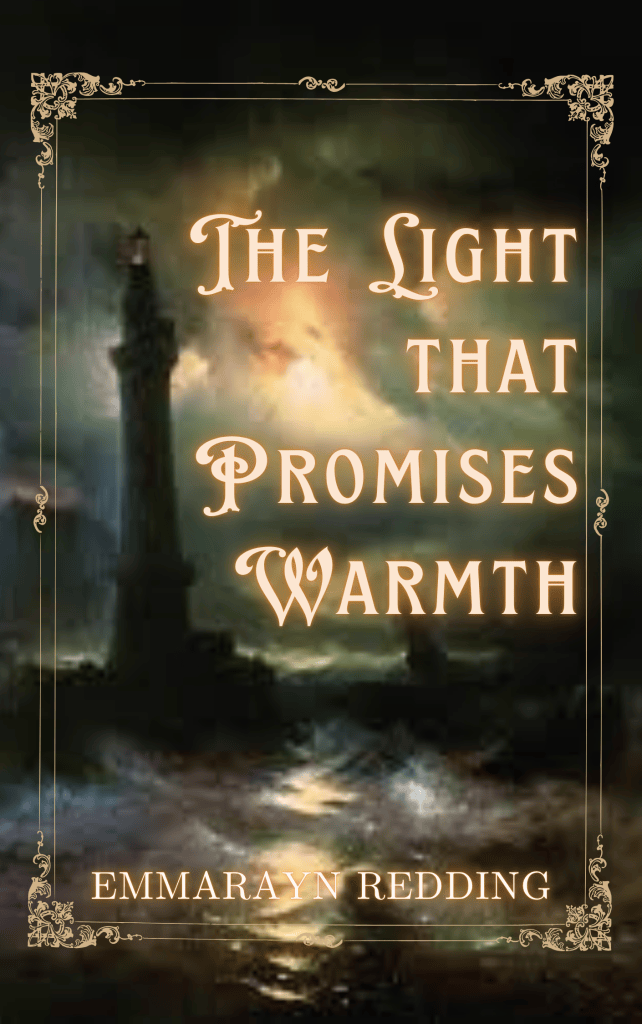
The Light That Promises Warmth
Originally Published in Clean Fiction Magazine, Winter 2025 Edition
* * *
THROUGH MY WINDOW, I saw them for the first time as they danced upon the waves, pulsating with living light like the beams of falling stars. There was something almost human in the way they whirled, with arms waving and bodies twisting in an exultant symphony of movement. They congregated in clusters, whorls that sparkled in the darkness of the dusk before scattering to dance once more in kaleidoscopic patterns.
I stood in amazement before the third window of my lighthouse, poised on the steps with a jug of kerosene half-forgotten in each hand. Before long, the weight of them roused me from my stupor and I set them hurriedly down. By the time I glanced back up, the lights were gone, and the restless waters heaved with the same shadow and foam as they always did.
I thought at first these strange lights were confined to the water, but I soon discovered this to be untrue when I caught their glimmer out of the corner of my eye as I dug up clams on the shore. A wet gust of wind whipped through my skirts, but the cold in my stiff fingers receded by a fraction. I turned, expecting the lights to vanish into the mist as they often did when they wandered the waves. But that day they stayed, dancing high on the bluffs, heedless of the steady drizzle. They stayed for almost a full minute while I stood in awe.
The wonder I felt in their presence was as irresistible as sleep at the end of a weary day, or appetite when confronted with a succulent meal. Nevertheless, I ignored them–I dared not give them more attention than fleeting moments of fascination. I had to ignore them because they were not, could not be real. They were mirages; the same beautiful lights that had haunted my father for months before he died.
Folk on the mainland used to whisper about him back then. He and I used to get into town more often, and as we walked through the rainy streets I saw them glance our direction with gazes that once held admiration and now turned to pity. They said he’d gone mad.
“It’s the solitude,” they whispered below the din in the pub, unaware how easily I heard them. “Deirdre’s passing put him all out of sorts. Them lights is nothing more than yearning, see.”
I knew their surmising was not mean-spirited, but I took it as a criticism all the same. I clung even closer to him, sensing, if not fully knowing, they were his final days. I wanted only to be a comfort. And once he was laid to rest near my mother, I couldn’t bear to leave the island.
I seldom went to town now. My cottage was small and warm and familiar, the climb up the spiraling stair to the lantern room arduous, but ritualistic. I made chowder and tea often, and spoke to the gulls that sang with the wind. I painted the churning waves as if they were my own family. In keeping my little beacon amongst the coastal shoals, I had at least the comfort of purpose. Apart from occasional pangs of loneliness, I’d thought I was better off than my parents… but the presence of the lights now told me that I, too, was mad and desolate.
I sat at my kitchen table, paintbrush in hand in the glow of lamplight, gazing at the still more dazzling lights out on the shore, writhing amongst the rising tide. They lifted their arms, beckoning to me, and I sucked in my breath, clenching the brush tight. A swell of longing surged in me, sharp and immediate. I shut my shade. They no longer vanished so readily; now I was the first to retreat.
“I ought to tell Tom.” I spoke aloud to dispel the silence of my home. Tom was the supernumerary keeper who’d come to relieve my father every month, and now came for me. A tall, long-nosed man of thirty-five who used to sail for a living, he always brought with him an air of adventure, but also another sort of pleasantness that I looked forward to even more than the holiday. Whether it was love or good association, I couldn’t say.
Yet when Tom came up to the house from the dory the next morning, I told him about the new book I’d read by M.R. James instead.
He smiled and steadied his hat against a gust of wind. “You’re of stern stuff, Bridie, if you read that in this place.”
His smile was like a parting of clouds, bright and warm. I was too shy to tell him I’d rather not go to shore for my leave. I left him in my house and let the dory men take me back to the mainland, where I avoided town and stayed in the country inn that kept a room ready for me.
I wondered whether the lights would follow me even here, but when a fortnight passed without a flicker, I wondered whether I’d ever seen them at all. I roamed all over the fields, following hedgerows and plucking up knapweed and rosebay to dry for my cottage.
Another fortnight found me back in the dory, pitching with the rise and fall of the ocean as the men returned me to the lighthouse. Tom had his pack ready when I disembarked, and shook my hand warmly. I tried not to hold too tight, and gave him my best smile.
“You’ll be alright, out here alone?” he asked, lingering. “There’s a storm coming down from the north–it’ll be a bad one.”
“I’ll batten down the hatches,” I told him. There was some reluctance in his stance which I attributed to human concern, and dismissed accordingly. My father and I had always been independent people, despite the pang in my chest.
Tom’s storm arrived in angry black rolling clouds that turned the sky into a roiling ocean and whipped the sea into a ferocious temper. Thick dark waves stretched up to paw at my doorstep, while the walls of the cottage shuddered and cowed before the wind’s wrath.
For days it raged on, the maelstrom keeping my strength in constant demand as I ascended the steps to the lantern room, kerosene in hand and coat buttoned up to my nose. By the fourth day I was in a fugue of exhaustion, uncertain what was day and what was nightmare.
I hardly knew when I’d made it to the bluffs, but I suddenly became aware that I was straining against the freezing rain with something like the warmth of the sun gleaming on my face. One of the lights stood there on the precipice, his shimmering arms extended toward me in a beseeching pose while the others danced on the waves below. It was Tom, his bright face as beautiful as it was in human form, though a mask had been lifted and desire glimmered in his eyes with mirific color. “Come! Dance with us, Bridie!”
The yearning in my chest overwhelmed me, but I took only half a step toward him with my own hand outstretched before a pair of arms clasped my waist and held fast, so warm and solid that the warmth of the mirage seemed cold by comparison.
“Don’t!” Tom’s voice sounded in my ear, his cheek touching my hair. “Don’t, Bridie!”
I cried out as the shining figure before me vanished, winking out as a powerful blast of wind and rain drove Tom and I backward. We stumbled and slipped, crashing down on the rocks.
I lay stunned and drenched, rain pelting my face as the wind buffeted our prone forms. Yet without warning, the storm slackened, torrential downpour slowing to a gentle drizzle, wind guttering into a sullen sigh. Dark clouds thinned, and a patch of light fell on us. The bluffs where I had stood, ready to follow that gleaming siren, were empty.
Tom’s hand lay against mine, and I heard his exhausted breaths. His body seemed to tremble, and I wondered how hard he must have fought to make it here through the maelstrom.
“Are you alright?” he asked after a moment without rising. “They nearly had you.”
“How did you know?” I asked, breathless.
“I saw the painting you left,” he replied “I’ve seen them too. One of them got close–only she wore your face. Her smile was wrong… it dared me to venture out, but yours asks me to stay.”
“This one… he offered freedom. Adventure.”
“That isn’t what you want, Bridie.”
It was true. Though the rock beneath my back was cold and wet, it was mine. “I love this island,” I said.
“I know.”
“You’ve always come back, Tom. Do you also love this place?”
“I love you,” he said. “The island is nice too. And I don’t think the lights will bother us if we’re happy as we are. They’d have nothing left to tempt us with anyway.”
* * *

