
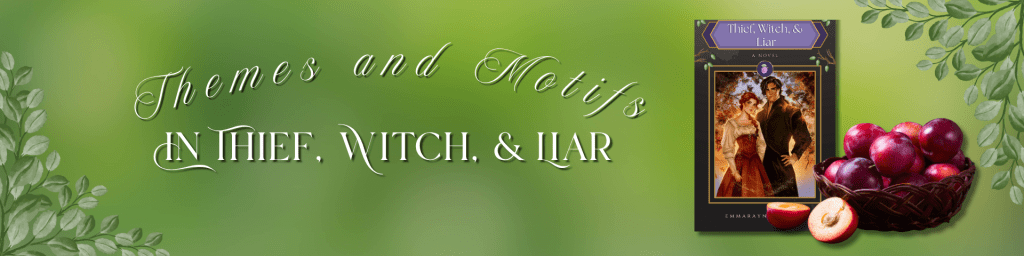
Themes and Motifs in Thief, Witch, & Liar:
Part I
MEDIA LITERACY
When I was growing up, I was taught that it was important to look into the stories I was consuming and understand what messages they were trying to communicate. To dig deep into the worldviews, concepts, and traditions that had helped to influence the creation books and movies and plays I experienced.
To this day, this is still something I enjoy. Recognizing certain themes or clever repetitions used to craft an unforgettable story adds an extra layer of excitement to the media I absorb; it can help to identify ideas that encourage or inspire me, or it can reveal subtle statements that I may even disagree with. It’s like getting a story within a story, if you will. Two for the price of one!
Not every narrative work in existence has a particularly deep meaning. To paraphrase the quote attributed to that influential historical psychologist, sometimes a story is just a story.
Nevertheless, it’s my opinion that the best stories, the ones that really matter, demonstrate themselves to contain traceable themes and motifs that elevate them from the ordinary and make them extraordinary, even if unconsciously done on the part of their creators. It’s something I keep in mind when creating my own stories–I aspire to become adept at weaving in themes of beauty and light and hope to each of my works, like the writers I have so admired over the years.
THIEF WITCH & LIAR
To tell the truth, I did not set out originally to incorporate any deliberate themes in Thief Witch & Liar. I read the fairy tale and found it to be at least somewhat unique for various reasons, and got it into my head that I wanted to retell it. It was purely for fun–a story for the story’s own sake.
But early on in writing it (really before I had actually begun to write the actual words of the tale), I realized that there were in fact some bigger ideas involved in the plot. Ideas that were perhaps not exactly present in the original narrative, but that were now presenting themselves the more I worked out the details of my vision for the novel. It made me pause and ask my self, “Why am I telling this story? Why does it appeal to me? And very soon, the answers began to clarify.
Armed with this new understanding of the tale I wanted to tell, I went into it with deliberate purpose to weave these ideas in through the first chapter and out through the last. I hope I have been successful, and at the very least, I was grateful for the experience of doing it for my own sake. And now that the book has been out for just over a month, I feel it’s safe enough to discuss these themes and motifs with you, my readers!
In the next three weeks, I’m drawing to some choice themes and motifs out to talk about them in depth. Spoilers may occurr–but if you haven’t read the book yet, never fear: I’ll mark the worst of the spoilers appropriately, so you can still enjoy the overall blogs.
Join me as we take a deeper look at Thief, Witch, & Liar.
WEEK ONE THEME:
True Love

The first of three major themes, True Love is a prevalent throughout the book in the form of an unspoken question: what counts as love?
The novel opens with a quote from I Corinthians 13:4-7.
Love is patient and kind. It does not envy or boast, and it is not proud. It does not dishonor others; it is not self-serving, nor is it easily angered. Love keeps no record of wrongs.Love delights not in evil, but rejoices in Truth. It always protects, always trusts, always hopes, and always perseveres. Love never fails.
This statement defines the highest ideal of love. But as many people have learned, people do not often measure up to this ideal. Their ‘love’, while it may be genuine, is unhealthy, even bad.
The term ‘love’ is applied several times throughout the book to the feelings and actions of various characters; but not every character who claims it demonstrates true love. Some of the ‘love’ demonstrated is corrupted at best, and wicked at worst–more akin to possession than the selfless love described in the passage above. The question for the reader to discover over the course of the novel is, who among these characters is truly loving?
WEEK ONE MOTIF
Hunger

“Hope deferred makes the heart sick, but a desire fulfilled is a tree of life.” –Proverbs 13:12
The hunger motif of Thief, Witch, & Liar begins in chapter one, when Daniela, the narrator and main character, describes the famine that ravaged her village, resulting in the loss of her older brother’s life and the eventual servitude that the townspeople enter under the Witch in exchange for her magic to ease their suffering.
Hunger reappears several times throughout the book. Hunger drives Daniela’s decision to take plums from the tree she later discovers to belong to the Witch Iacoma, resulting in her capture and enslavement.
Iacoma withholds food from Daniela when she is displeased, and forbids her from even making meals for herself, restricting her to the consumption of leftovers from the dinner table–then later spoiling her with rich foods once Daniela has won a little of her favor.
Iacoma’s sister, the Mountain Witch, deprives her least favorite servant of food to the point of near starvation.
SPOILER TALK: ((On a deeper level, Hunger represents the desire for affection. Bensiabel gives up parts of his meals under the guise of being picky in order to alleviate Daniela’s hunger, willingly subjecting himself to hunger in hopes of receiving her affection in return. Daniela, before learning of Bensiabel’s secret gentleness, notes a “hungry” look in his eyes when he looks at her, attributing it first to lust before she eventually learns how much he craves her approval and tenderness. Once she understands, she too becomes a provider, alleviating his pain by becoming a true companion.))
Check in next week for the second installment of Themes and Motifs in Thief, Witch, & Liar –True Goodness and Knight&Damsel!
 Glorious Stories
Leave a comment